


Equip your lab with names that are clear, professional, and easy to remember. This collection of lab equipment names is packed with ideas for science, chemistry, and biology labs, helping students, educators, and researchers organize their space effectively. Each name is designed to be precise, practical, and easy to identify, making lab Equipment work smoother and more efficient. And if you want something tailored or creative, the Lab Equipment Names Generator can instantly create personalized name ideas that perfectly fit your lab’s setup and needs.
Basic Lab Equipment Names and Their Uses
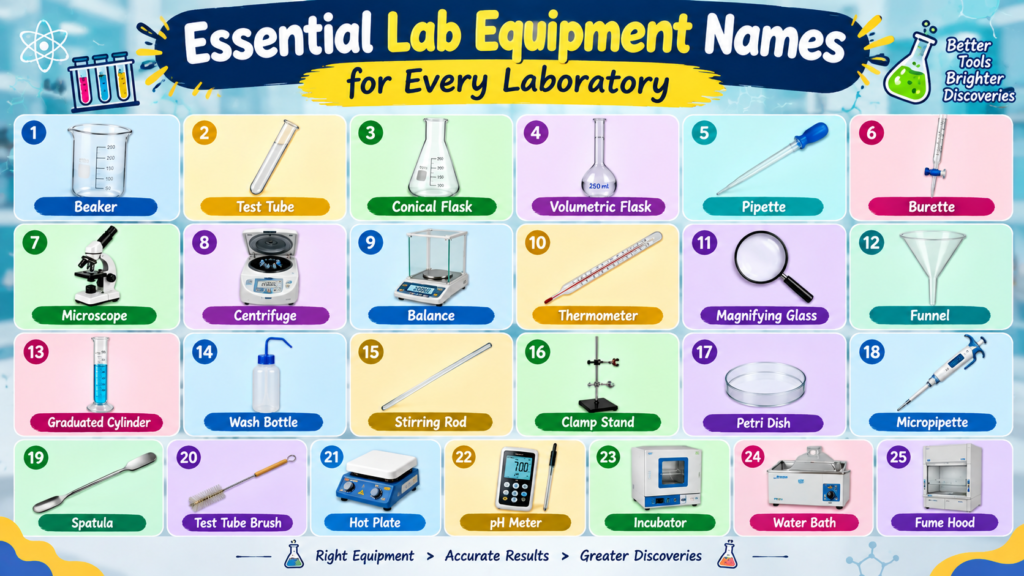
- Beaker – Used for mixing, stirring, and heating chemicals.
- Test Tube – Holds small samples or conducts small-scale reactions.
- Graduated Cylinder – Measures accurate volumes of liquids.
- Pipette – Transfers small quantities of liquid precisely.
- Burette – Measures and delivers specific volumes of liquids during titrations.
- Flask (Erlenmeyer Flask) – Used for mixing chemicals with minimal spillage.
- Volumetric Flask – Prepares precise standard solutions.
- Funnel – Helps in transferring liquids or powders into containers with small openings.
- Dropper – Adds small amounts of liquid drop by drop.
- Petri Dish – Cultures microorganisms or small specimens.
- Microscope – Magnifies small objects or organisms for observation.
- Slide and Cover Slip – Holds and covers specimens for microscopic examination.
- Thermometer – Measures temperature of substances.
- Bunsen Burner – Provides heat for experiments, sterilization, and heating chemicals.
- Test Tube Holder – Holds test tubes during heating or handling.
- Test Tube Rack – Organizes and supports test tubes upright.
- Tongs – Holds hot apparatus such as crucibles or beakers.
- Crucible – Heats solids at very high temperatures.
- Mortar and Pestle – Grinds solids into fine powders.
- Balance (Electronic or Triple Beam) – Measures the mass of substances accurately.
- Stirring Rod – Mixes chemicals and assists in decanting liquids.
- Wash Bottle – Rinses glassware or adds small amounts of water to reactions.
- Evaporating Dish – Heats and evaporates liquids to leave solid residues.
- Watch Glass – Covers beakers or holds small samples for observation.
- Retort Stand (Ring Stand) – Supports clamps and equipment during experiments.
- Clamp and Boss Head – Holds test tubes, flasks, or burettes securely on a stand.
- Wire Gauze – Distributes heat evenly when heating glassware with a Bunsen burner.
- Tripod Stand – Supports beakers or flasks during heating.
- Desiccator – Stores dry substances and prevents moisture absorption.
- Spatula or Scoopula – Transfers solid chemicals safely.
- Hot Plate – Heats substances without an open flame.
- pH Meter – Measures the acidity or alkalinity of solutions.
- Centrifuge – Separates mixtures by spinning at high speeds.
- Test Tube Brush – Cleans test tubes and small glassware.
- Incubator – Maintains optimal temperature for microbial or cell growth.
- Pipette Bulb – Helps in drawing liquids into pipettes safely.
- Forceps (Tweezers) – Handles small specimens or objects.
- Measuring Pipette – Measures and transfers exact liquid volumes.
- Thermostat Water Bath – Maintains substances at a constant temperature.
- Dropper Bottle – Stores and dispenses small amounts of liquid.
- Gas Jar – Collects gases during experiments.
- Safety Goggles – Protects eyes from chemical splashes or debris.
- Lab Coat – Protects the body and clothing from spills and contamination.
- Gloves – Shields hands from chemicals and biological agents.
- Fume Hood – Prevents inhalation of toxic fumes or gases.
- Test Tube Brush – Cleans inside narrow glassware and test tubes.
- Measuring Cylinder – Measures liquid volumes accurately in experiments.
- Filter Paper – Used for separating solids from liquids during filtration.
- Condenser – Cools hot vapors into liquids during distillation.
- Distillation Apparatus – Separates mixtures based on boiling points.
- Thermometer Clamp – Holds thermometers securely during heating.
- Reagent Bottle – Stores chemicals safely in the laboratory.
- Dropping Pipette – Adds controlled amounts of liquid in reactions.
- Stirring Hot Plate – Heats and stirs solutions simultaneously.
- pH Paper – Tests the acidity or alkalinity of substances.
- Safety Tongs – Handles heated materials or equipment.
- Glass Rod – Mixes or transfers liquids safely.
- Weighing Boat – Holds solids while weighing them on a balance.
- Cork Borer – Cuts holes in corks or rubber stoppers for apparatus fitting.
- Test Tube Cap – Seals test tubes to prevent contamination or evaporation.
- Digital Balance – Provides accurate mass measurements of samples.
- Heating Mantle – Provides even heating for round-bottom flasks.
- Pipette Stand – Holds pipettes in an upright position after use.
- Desiccant Jar – Keeps chemicals moisture-free for storage.
- Measuring Flask – Used to prepare accurate volumes of standard solutions.
- Separating Funnel – Separates immiscible liquids in chemical reactions.
- Watch Glass Dish – Holds samples for drying or observation.
- Evaporator – Removes solvents from mixtures using heat.
- Magnetic Stirrer – Uses a magnetic field to stir liquids automatically.
- Thermocouple – Measures high temperatures precisely.
- Safety Shield – Protects users from splashes or reactions.
- Digital Thermometer – Provides accurate temperature readings.
- Burner Stand – Supports Bunsen burners and glassware during heating.
- Boiling Tube – Used for heating larger liquid volumes than test tubes.
- Test Tube Clamp – Holds test tubes securely during experiments.
- Micro Pipette – Measures and transfers very small liquid volumes.
- Glass Funnel – Used for filtering or transferring liquids.
- Beaker Tong – Safely lifts or moves hot beakers.
- Reflux Condenser – Cools and condenses vapors during reflux reactions.
- Round Bottom Flask – Used for uniform heating during reactions.
- Flat Bottom Flask – Used for holding and heating liquids.
- Volumetric Pipette – Measures a fixed volume of liquid precisely.
- Weighing Balance – Used for measuring mass in laboratories.
- Clay Triangle – Supports crucibles during heating.
- Deflagrating Spoon – Holds solids while heating to study combustion.
- Crucible Tong – Used to hold hot crucibles or lids.
- U-Tube – Used in gas collection and chemical tests.
- Gas Syringe – Collects and measures gas volumes accurately.
- Spatula – Transfers small amounts of solid substances.
- Boiling Chips – Prevents bumping during boiling.
- Measuring Bottle – Used to measure and store reagents safely.
- Glass Stirrer – Mixes liquids during experiments.
- Oven (Laboratory Oven) – Dries glassware and removes moisture from samples.
- Scoopula – Scoops powdered chemicals.
- Capillary Tube – Used in chromatography or to determine melting points.
- Dissecting Needle – Used for separating fine tissue during dissections.
- Petri Plate – Cultures microorganisms or grows bacteria colonies.
- Wash Glass – Covers and prevents contamination of samples.
- Gas Burner – Provides consistent flame for heating.
- Rubber Stopper – Seals test tubes and flasks to prevent gas escape.
- Dropping Funnel – Adds liquids dropwise during reactions.
- pH Indicator – Determines whether a substance is acidic or basic.
- Vortex Mixer – Mixes small vials of liquid quickly and efficiently.
Read More: Best Teacher Podcast Names for Educators and Creators
Common Chemistry Lab Equipment Names
- Beaker
- Test Tube
- Graduated Cylinder
- Erlenmeyer Flask
- Volumetric Flask
- Burette
- Pipette
- Funnel
- Dropper
- Watch Glass
- Petri Dish
- Evaporating Dish
- Crucible
- Mortar and Pestle
- Measuring Cylinder
- Reagent Bottle
- Condenser
- Distillation Apparatus
- Separating Funnel
- Round Bottom Flask
- Flat Bottom Flask
- Boiling Tube
- Test Tube Rack
- Test Tube Holder
- Test Tube Clamp
- Retort Stand (Ring Stand)
- Clamp and Boss Head
- Wire Gauze
- Tripod Stand
- Bunsen Burner
- Burner Stand
- Hot Plate
- Heating Mantle
- Magnetic Stirrer
- Stirring Rod
- Centrifuge
- pH Meter
- Thermometer
- Thermocouple
- Digital Thermometer
- Balance (Electronic or Triple Beam)
- Weighing Boat
- Weighing Balance
- Spatula or Scoopula
- Cork Borer
- Forceps (Tweezers)
- Filter Paper
- Desiccator
- Desiccant Jar
- Gas Jar
- Gas Syringe
- U-Tube
- Clay Triangle
- Deflagrating Spoon
- Safety Tongs
- Crucible Tong
- Beaker Tong
- Glass Funnel
- Dropping Funnel
- Dropping Pipette
- Micro Pipette
- Volumetric Pipette
- Measuring Pipette
- Pipette Bulb
- Pipette Stand
- Wash Bottle
- Wash Glass
- Glass Rod
- Evaporator
- Oven (Laboratory Oven)
- Reflux Condenser
- Boiling Chips
- pH Paper
- pH Indicator
- Thermostat Water Bath
- Incubator
- Safety Shield
- Safety Goggles
- Gloves
- Lab Coat
- Fume Hood
- Filter Funnel
- Distillation Flask
- Graduated Pipette
- Conical Flask
- Test Tube Cap
- Rubber Stopper
- Measuring Bottle
- Petri Plate
- Capillary Tube
- Dissecting Needle
- Vortex Mixer
- Digital Balance
- Power Supply Unit (for experiments)
- Electrode Pair (for electrolysis)
- Conductivity Apparatus
- Gas Collection Tube
- Glass Tubing
- Connecting Tube
- Dropping Bottle
- Stirring Hot Plate
- Vacuum Pump
- Manometer
- Pressure Gauge
- Spectrophotometer
- Colorimeter
- Microscope
- Slide and Cover Slip
- Thermometer Clamp
- Reagent Dropper
- Storage Cabinet
- Labeling Tape
- Funnel Stand
Biology Lab Equipment Names for Students
- Microscope
- Magnifying Glass
- Slides and Cover Slips
- Petri Dish
- Test Tubes
- Beakers
- Flasks (Erlenmeyer and Volumetric)
- Graduated Cylinder
- Pipette
- Dropper
- Dissecting Tray
- Dissecting Scissors
- Scalpel
- Forceps (Tweezers)
- Dissecting Needle
- Probe
- Specimen Jar
- Watch Glass
- Evaporating Dish
- Test Tube Rack
- Test Tube Holder
- Test Tube Brush
- Centrifuge
- Glass Rod
- Microscope Stand
- Thermometer
- pH Paper
- Measuring Cylinder
- Reagent Bottle
- Funnel
- Filter Paper
- Wash Bottle
- Beaker Tongs
- Petri Plate
- Slide Box
- Dissecting Microscope
- Compound Microscope
- Binocular Microscope
- Hand Lens
- Inoculating Loop
- Hot Plate
- Water Bath
- Incubator
- Autoclave
- Sterilizer
- Safety Goggles
- Gloves
- Lab Coat
- Face Mask
- Safety Shield
- Balance (Electronic or Triple Beam)
- Weighing Boat
- Mortar and Pestle
- Test Tube Clamp
- Tripod Stand
- Wire Gauze
- Bunsen Burner
- Spirit Lamp
- Gas Burner
- Retort Stand (Ring Stand)
- Clamp and Boss Head
- Sample Bottle
- Specimen Tube
- Petri Film
- Culture Tube
- Dropper Bottle
- pH Meter
- Micropipette
- Microscope Slides Box
- Preserved Specimens
- Microscope Cover Glass
- Light Microscope
- Dissection Kit
- Test Tube Cap
- Evaporator
- Thermostat Water Bath
- Glass Funnel
- Filter Funnel
- Measuring Flask
- Magnifier Lamp
- Glass Slide Holder
- Dissecting Forceps
- Drying Oven
- Cork Borer
- Needle Holder
- Lab Notebook
- Sterile Swab
- Cuvette
- Haemocytometer
- Blood Slide
- Petri Rack
- Staining Rack
- Autoclave Tape
- Lab Timer
- Digital Microscope
- Specimen Tray
- Counting Chamber
- Dissecting Table
- Centrifuge Tubes
- Beaker Brush
- Microscope Cleaning Paper
- Digital Thermometer
- Micropipette Tips
- Buffer Bottle
- Storage Cabinet
- Waste Disposal Bin
- Labeling Tape
- Marker Pen
- First Aid Kit
Physics Lab Equipment Names and Functions
- Ammeter – Measures the electric current flowing through a circuit.
- Voltmeter – Measures the potential difference (voltage) between two points.
- Galvanometer – Detects and measures small electric currents.
- Multimeter – Measures voltage, current, and resistance in electrical circuits.
- Ohmmeter – Measures electrical resistance in a conductor.
- Resistor – Controls and limits the flow of electric current in a circuit.
- Rheostat – Adjusts the current flow by varying resistance.
- Capacitor – Stores electrical energy in an electric field.
- Inductor – Stores energy in a magnetic field when current passes through it.
- Battery – Provides a steady source of electrical energy.
- Power Supply Unit – Supplies electric power to various circuit components.
- Switch – Opens or closes an electric circuit to control current flow.
- Key (Plug Key) – Acts as a manual switch in electric circuits.
- Fuse – Protects circuits from excessive current by melting when overheated.
- Transformer – Changes voltage levels in AC circuits.
- Generator – Converts mechanical energy into electrical energy.
- Motor – Converts electrical energy into mechanical energy.
- Galvanic Cell – Produces electric current from a chemical reaction.
- Electroscope – Detects the presence and magnitude of electric charge.
- Gold Leaf Electroscope – Measures and detects electric charge using gold leaves.
- Electromagnet – Generates a magnetic field when current flows through it.
- Magnet Bar – Demonstrates magnetic field properties and attraction forces.
- Horseshoe Magnet – Produces a strong magnetic field between its poles.
- Magnetic Compass – Shows the direction of the magnetic field or north-south line.
- Magnetic Needle – Used to indicate direction or test magnetic fields.
- Magnetic Field Lines Apparatus – Visualizes magnetic field patterns.
- Iron Filings – Demonstrates magnetic field patterns around magnets.
- Demonstration Dynamo – Shows the conversion of mechanical to electrical energy.
- Ammeter Shunt – Extends the measuring range of an ammeter.
- Meter Bridge – Measures unknown resistance using the principle of a Wheatstone bridge.
- Wheatstone Bridge – Determines the resistance of an unknown resistor.
- Potentiometer – Measures potential difference or compares EMFs.
- Resonance Apparatus – Demonstrates resonance phenomena in sound or electricity.
- Sonometer – Studies the relationship between frequency, tension, and length of a vibrating wire.
- Tuning Fork – Produces sound of a fixed frequency for resonance experiments.
- Pendulum – Demonstrates simple harmonic motion and measures acceleration due to gravity.
- Stopwatch – Measures time intervals accurately during experiments.
- Spring Balance – Measures force or weight based on Hooke’s law.
- Beam Balance – Measures mass using calibrated weights.
- Digital Balance – Measures mass precisely using electronic sensors.
- Meter Scale – Measures length or distance.
- Vernier Caliper – Measures internal and external diameters with high precision.
- Micrometer Screw Gauge – Measures very small lengths or thicknesses accurately.
- Protractor – Measures angles in mechanical and optical experiments.
- Inclined Plane – Demonstrates components of forces and friction.
- Pulley – Changes the direction of force and lifts loads with mechanical advantage.
- Force Table – Demonstrates the equilibrium of concurrent forces.
- Newton’s Cradle – Demonstrates conservation of momentum and energy.
- Parallelogram of Forces Apparatus – Shows the resultant of two concurrent forces.
- Mass Hanger and Slotted Weights – Provides known masses for force experiments.
- Spring Constant Apparatus – Measures the stiffness (k-value) of a spring.
- Friction Block – Demonstrates the laws of friction on different surfaces.
- Moment of Inertia Apparatus – Measures the rotational inertia of a body.
- Flywheel – Studies rotational motion and angular momentum.
- Stop Clock – Records precise time intervals.
- Photogate Timer – Measures time, speed, and acceleration in motion experiments.
- Air Track – Demonstrates motion with minimal friction.
- Ticker Timer – Records motion and acceleration using dots on a tape.
- Projectile Apparatus – Demonstrates projectile motion and parabolic trajectories.
- Inclined Plane with Trolley – Studies motion under uniform acceleration.
- Ripple Tank – Demonstrates the properties of water waves.
- Wave Generator – Produces mechanical or sound waves for experiments.
- Optical Bench – Mounts optical components for light experiments.
- Ray Box – Produces narrow light beams for refraction and reflection experiments.
- Prism – Disperses white light into its constituent colors.
- Lens (Convex/Concave) – Focuses or diverges light rays.
- Mirror (Plane/Concave/Convex) – Reflects light for optical studies.
- Lens Holder – Holds lenses in position during optical experiments.
- Mirror Holder – Keeps mirrors fixed at specific angles.
- Slit Plate – Produces narrow slits of light for diffraction experiments.
- Spectrometer – Measures angles of refraction, reflection, and dispersion of light.
- Telescope – Observes distant objects and aids in optical alignment.
- Microscope (Optical) – Magnifies small objects for observation.
- Polarimeter – Measures the angle of rotation caused by polarized light.
- Diffraction Grating – Splits light into multiple beams for spectral analysis.
- Thermometer – Measures temperature in thermal experiments.
- Thermocouple – Converts temperature difference into voltage.
- Barometer – Measures atmospheric pressure.
- Manometer – Measures pressure differences between gases or liquids.
- Hygrometer – Measures humidity in the air.
- Calorimeter – Measures heat energy exchange in physical or chemical processes.
- Heat Source (Burner or Hot Plate) – Provides heat for thermal experiments.
- Conductivity Apparatus – Demonstrates thermal and electrical conductivity.
- Specific Heat Apparatus – Determines the specific heat capacity of substances.
- Stopper Thermometer – Measures temperature in closed systems.
- Insulated Flask – Prevents heat loss during thermal experiments.
- Radiation Box – Demonstrates heat transfer by radiation.
- Sound Level Meter – Measures intensity of sound waves.
- Resonance Tube – Determines the speed of sound in air.
- Cathode Ray Tube – Demonstrates the behavior of electrons in an electric field.
- Ammeter Box – Contains multiple ammeters for circuit measurement.
- Resistor Box – Contains standard resistors for calibration.
- Capacitance Box – Provides variable capacitance values for experiments.
- Inductance Coil – Used in electromagnetic induction studies.
- Galvanometer Box – Measures small electric currents precisely.
- Vibration Generator – Produces mechanical vibrations for wave studies.
- Transformer Kit – Demonstrates step-up and step-down voltage changes.
- Digital Oscilloscope – Displays and analyzes varying electrical signals.
- Function Generator – Produces different types of waveforms for circuit testing.
- Laser – Produces a coherent beam of light for diffraction and interference experiments.
- Photocell – Converts light energy into electrical signals.
- Solar Cell – Demonstrates the conversion of light into electricity.
- Battery Eliminator – Supplies DC voltage to replace batteries in experiments.
- Resistor Board – Provides different resistance values for electrical setups.
- Plug Key – Connects or disconnects electrical circuits manually.
- Commutator – Reverses the direction of current in motors.
- Armature – The rotating part of an electric motor or generator.
- Magnetic Needle Compass – Shows magnetic field direction.
- Earth Inductor – Measures the horizontal component of the Earth’s magnetic field.
- Electric Bell – Demonstrates the working of electromagnets.
Advanced Scientific Lab Equipment Names
- Electron Microscope
- Scanning Electron Microscope (SEM)
- Transmission Electron Microscope (TEM)
- Atomic Force Microscope (AFM)
- Confocal Microscope
- Mass Spectrometer
- Gas Chromatograph (GC)
- High-Performance Liquid Chromatograph (HPLC)
- Ultracentrifuge
- X-Ray Diffractometer (XRD)
- Nuclear Magnetic Resonance Spectrometer (NMR)
- Fourier Transform Infrared Spectrometer (FTIR)
- UV-Visible Spectrophotometer
- Fluorescence Spectrophotometer
- Atomic Absorption Spectrometer (AAS)
- Inductively Coupled Plasma Mass Spectrometer (ICP-MS)
- Thermogravimetric Analyzer (TGA)
- Differential Scanning Calorimeter (DSC)
- Differential Thermal Analyzer (DTA)
- Gas Chromatography–Mass Spectrometry (GC-MS)
- Liquid Chromatography–Mass Spectrometry (LC-MS)
- Microplate Reader
- PCR Machine (Thermocycler)
- Gel Electrophoresis Apparatus
- DNA Sequencer
- RNA Synthesizer
- Protein Purification System
- Western Blot Apparatus
- Flow Cytometer
- Cell Counter
- Autoclave (Advanced Steam Sterilizer)
- Laminar Flow Hood
- Biosafety Cabinet
- Fume Hood (Advanced Air Filtration)
- CO₂ Incubator
- Cryogenic Freezer
- Refrigerated Centrifuge
- Vacuum Oven
- Rotary Evaporator (Rotavap)
- Freeze Dryer (Lyophilizer)
- Ultra-Pure Water System
- Spectrofluorometer
- Surface Plasmon Resonance (SPR) System
- Scanning Tunneling Microscope (STM)
- Microbalance
- Thermogravimetric Microbalance
- Viscometer
- Rheometer
- pH and Conductivity Meter
- Karl Fischer Titrator
- Electrochemical Workstation
- Gas Analyzer
- Oxygen Analyzer
- CO₂ Analyzer
- Atomic Emission Spectrometer
- Energy Dispersive X-Ray Analyzer (EDX or EDS)
- Ion Chromatograph (IC)
- Capillary Electrophoresis System
- Particle Size Analyzer
- Zeta Potential Analyzer
- Dynamic Light Scattering (DLS) Instrument
- Microwave Digestion System
- Sample Preparation Robot
- Automated Pipetting System
- Robotic Liquid Handler
- High-Throughput Screening System
- Environmental Chamber
- Humidity Chamber
- Vibration Isolation Table
- Cryostat
- Microtome
- Tissue Processor
- Histology Slide Stainer
- Spectrophotometer with Integrating Sphere
- Laser Scanning Confocal Microscope
- Optical Coherence Tomography (OCT) System
- Scanning Probe Microscope (SPM)
- Nanoparticle Analyzer
- Microplate Washer
- Gas Flow Controller
- Vacuum Pump (High-Precision)
- Spectroradiometer
- Colorimeter
- Flame Photometer
- Total Organic Carbon Analyzer (TOC)
- Water Activity Meter
- Refractometer
- Polarimeter
- Tensiometer
- Contact Angle Goniometer
- High-Temperature Furnace
- Plasma Cleaner
- Ion Milling Machine
- Thin Film Deposition System (CVD/PVD)
- Atomic Layer Deposition (ALD) System
- Glove Box (Inert Atmosphere Chamber)
- Mass Flow Controller
- Data Acquisition System (DAQ)
- Laser Doppler Velocimeter
- Ultrasonic Cleaner
- High-Speed Camera
- Radiation Detector
- Geiger-Müller Counter
- Scintillation Counter
- X-Ray Fluorescence (XRF) Spectrometer
- Thermal Conductivity Analyzer
- Magnetic Susceptibility Balance
- Electron Paramagnetic Resonance (EPR) Spectrometer
- Differential Refractometer
- UV Crosslinker
- DNA Microarray Scanner
- Protein Crystallization Robot
- Flow Reactor
Essential Lab Equipment Names for Research
- Microscope
- Centrifuge
- Spectrophotometer
- pH Meter
- Hot Plate
- Magnetic Stirrer
- Vortex Mixer
- Autoclave
- Incubator
- Water Bath
- Analytical Balance
- Digital Weighing Scale
- Refrigerator
- Freezer
- Fume Hood
- Laminar Flow Cabinet
- Pipette (Micro and Macro)
- Pipette Tips
- Beaker
- Flask (Erlenmeyer, Volumetric, and Round Bottom)
- Test Tubes
- Graduated Cylinder
- Petri Dish
- Reagent Bottle
- Watch Glass
- Glass Funnel
- Filter Paper
- Desiccator
- Vacuum Pump
- Distillation Apparatus
- Rotary Evaporator (Rotavap)
- Micropipette Stand
- Burette
- Condenser
- Separating Funnel
- Magnetic Stir Bar
- Ultrasonic Cleaner
- Vacuum Oven
- Drying Oven
- Heating Mantle
- Water Purification System
- Ultrapure Water System
- Refrigerated Centrifuge
- Microcentrifuge
- Cryogenic Freezer
- Spectrometer
- Gas Chromatograph (GC)
- High-Performance Liquid Chromatograph (HPLC)
- PCR Machine (Thermocycler)
- Gel Electrophoresis Unit
- Power Supply Unit
- UV-Visible Spectrophotometer
- Fluorescence Microscope
- Compound Microscope
- Inverted Microscope
- Microplate Reader
- Microplate Washer
- CO₂ Incubator
- Biosafety Cabinet
- Glove Box (Inert Atmosphere Chamber)
- Autoclave Sterilizer
- pH and Conductivity Meter
- Thermostatic Water Bath
- Temperature Controller
- Refrigerated Shaker
- Orbital Shaker
- Magnetic Stirring Hot Plate
- Vacuum Filtration Unit
- Centrifuge Tubes
- Microtubes
- Sample Vials
- Analytical Columns
- Desiccant Jar
- Manometer
- Gas Flow Controller
- Oxygen Analyzer
- Conductivity Cell
- Humidity Chamber
- Environmental Chamber
- Refractometer
- Polarimeter
- Spectrofluorometer
- Thermogravimetric Analyzer (TGA)
- Differential Scanning Calorimeter (DSC)
- Viscometer
- Rheometer
- Electrophoresis Power Supply
- Gel Documentation System
- Ultracentrifuge
- Microwave Digestion System
- High-Speed Camera
- Spectrometer with Integrating Sphere
- Laser System
- Data Logger
- Vacuum Desiccator
- Plasma Cleaner
- High-Temperature Furnace
- Temperature Probe
- Magnetic Field Generator
- Gas Analyzer
- Chromatography Column Rack
- Sample Storage Cabinet
- Cryostat
- Tissue Homogenizer
- Glassware Drying Rack
- Safety Goggles
- Lab Coat
- Protective Gloves
- First Aid Kit
FAQs about Lab Equipment Names
What are some creative lab equipment name ideas?
Names like BeakerBuddy, TestTubePro, FlaskFinder, and MicroscopeMaster make lab tools fun and memorable.
Can these names be used for both educational and professional labs?
Yes, these names are suitable for classrooms, research labs, and science workshops.
How do I make a lab equipment name catchy?
Use alliteration, descriptive words, or playful terms that reflect the tool’s function, like MixMaster or SlideScope.
Are these names suitable for digital lab apps or simulations?
Absolutely! Names like LabMate, Experimenter, and LabLogic work well for educational apps and virtual labs.
Can I create themed names for multiple lab tools?
Yes, you can group names like BeakerBuddy, TestTubePro, and FlaskFinder for a cohesive lab theme.
Conclusion
Lab Equipment Names for Science, Chemistry & Biology Labs offers a wide array of creative, fun, and practical naming ideas for lab tools and equipment. From clever names like BeakerBuddy and TestTubePro to innovative picks like FlaskFinder and MicroscopeMaster, each name adds personality and clarity to your scientific environment. These names are perfect for educational classrooms, research labs, and virtual simulations, making it easier to identify equipment while inspiring curiosity and engagement. By giving your lab tools unique and memorable names, you enhance organization, learning, and enjoyment in every experiment, ensuring science becomes both structured and exciting.
